Menu
Curtains
Accessories & Interior
Inspiration & Guides
Free curtain planning
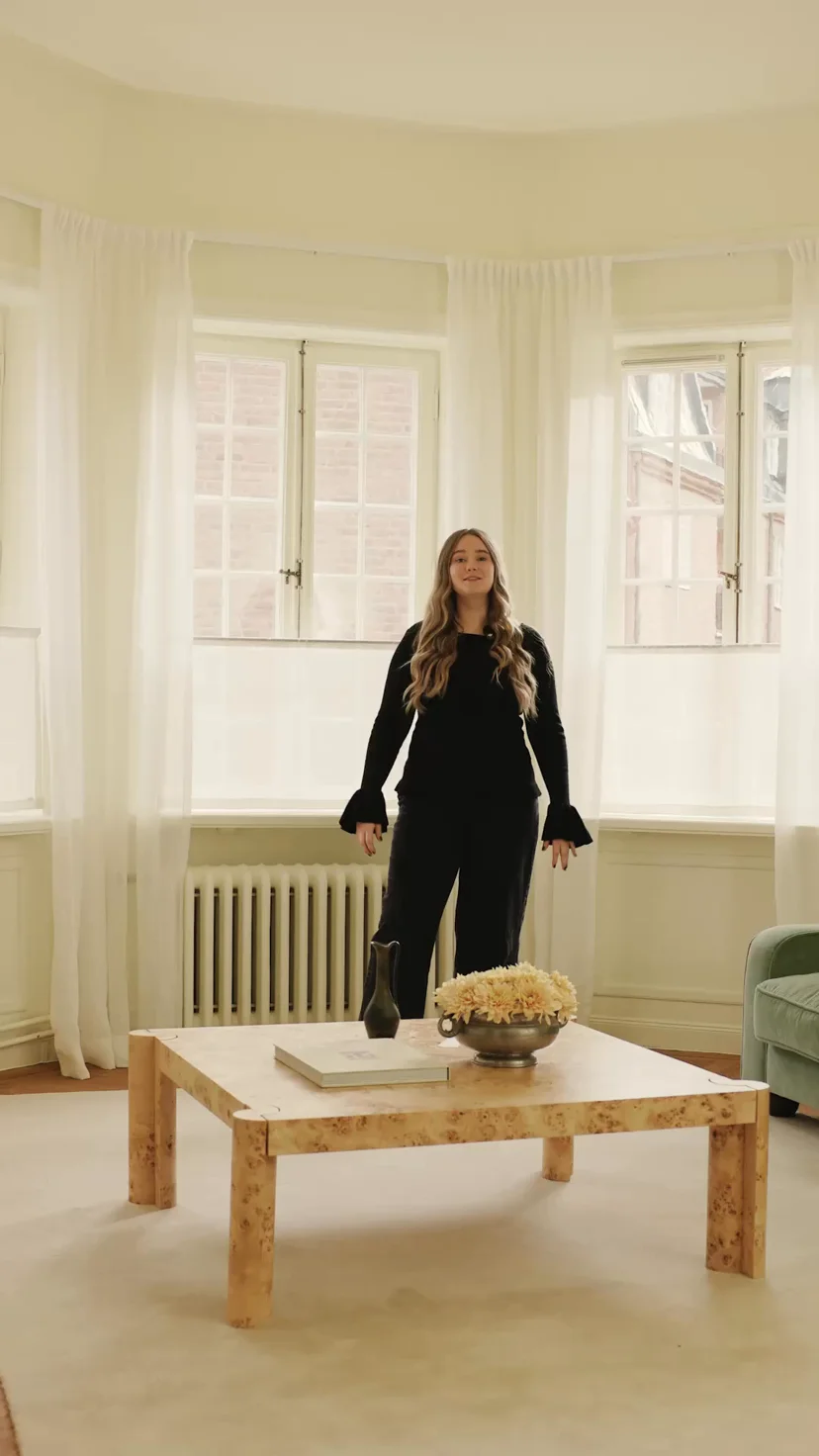
A bay window offers a variety of curtain solutions, from airy café curtains that let in natural daylight to Roman shades and full-length drapes that beautifully frame the windows. In this guide, we show you step by step how to measure your windows and angles to find the perfect solution for your bay window. With made-to-measure curtains and custom-made corner connectors for curtain tracks, you can create a curtain solution that follows the shape of your bay window.
Café Curtains for Bay Windows
Roman Shades for Bay Windows
Drapery Panels for Bay Windows
Café Curtains for Bay Windows
When measuring for café curtains in a bay window, the same principles apply as for a standard window. The main difference may be how the windows are positioned in relation to one another. Window trim often divides the bay window into separate sections, meaning each café curtain needs to be measured individually.
Start by choosing your preferred café curtain style – classic, minimalist or with rings. Then consider how your window opens to determine which mounting option is best: niche brackets or window frame brackets.
Café Curtain Minimalist
Café curtain classic
Café curtain with rings
Step 2: Choose the Right Mounting Option for Your Window
Niche brackets
Niche brackets are installed inside the window recess and are particularly suitable for outward-opening windows. The curtain rod runs across the width of the window recess and stays in place when the window is opened.
How to Measure:
Measure the width of the window recess where the curtain rod will be installed.
Round the measurement down to the nearest whole centimetre.
Window Brackets
Window frame brackets are mounted directly onto the window sash, allowing the curtain to move with the window when it opens. They are a great option for inward-opening windows or if you want to open the window without having to move the curtain.
How to Measure:
Measure the total width where the curtain rod will be installed, usually the width of the windowpane including the frame.
Enter the full width measurement when placing your order. We will automatically adjust the fabric width based on your chosen café curtain style.
Good to know: Each bracket is 0.4 in (1 cm) wide and is positioned 1.2 in (3 cm) from the end of the curtain rod. This means a total of 3.1 in (8 cm) of the rod's width will remain uncovered by fabric.
Step 3: Determine the Curtain Length
Café curtains usually cover the lower part of the window, providing privacy while allowing natural daylight to enter through the upper section. Start by deciding at what height you want to position the curtain rod.
Then measure from the position of the curtain rod down to where you want the curtain to end. Subtract 0.4-0.8in (1–2 cm) so that the curtain hangs slightly above the windowsill. This allows the fabric to fall freely while the weighted hem tape helps it hang beautifully and evenly.
For café curtains with rings: Please note that the curtain hangs 0.8 in (2 cm) below the top edge of the curtain rod. Therefore, subtract an additional 0.8 in (2 cm) from your measured length.
Roman shades for Bay Windows
Roman shades are a beautiful option for bay windows, allowing you to easily control both natural light and privacy. Start by looking at how the windows are positioned – whether there is wall space between them or if they meet directly in the corners. This determines how wide the shades can be and how they should be positioned in relation to one another.
Height
Start by deciding how high above the window you want to install the Roman shade. We recommend at least 2.8 in (7 cm) above the window trim to allow enough space for the cord lock.
If you want to create the impression of higher ceilings, you can instead position the shade approximately 5.9 in (15 cm) above the window trim. Then measure from your chosen mounting height down to the windowsill or to the point where you want the shade to end.
Good to know: A fully raised Roman shade takes up approximately 9.8-11.8 in (25–30 cm) in height. Keep this in mind when choosing the mounting height so that the shade does not cover too much of the window when raised.
Width
Measure the total width of the window, including the window trim. Add 0.4-0.8 in (1–2 cm) on each side so that the shade covers the window trim and neatly frames the window. If you choose a blackout Roman shade, you may want to add a few extra inches (centimetres) on each side to minimise light entering around the edges.
If the Windows Are Close Together
If the windows in your bay window meet directly in the corners with no wall space between them, you need to consider the positioning of the Roman shades. Make sure there is enough space between the blinds so that they do not touch and can be raised and lowered without obstruction.
Bay Windows with 135° Angles
The side shades can be ordered according to their measured widths, creating a small additional overlap towards the outer edges of the bay window.
The centre shade should be ordered 0.8-1.2 in (2–3 cm) narrower than the measured width so that the shades can meet in the corners without touching each other.
Bay Windows with 90° Corners
For bay windows with 90° corners, you need to consider how far the Roman shades project from the wall to prevent them from interfering with each other where they meet. Our standard brackets are 1.2 in (3 cm) deep, meaning the shades project a total of 1.5 in (4 cm) from the wall.
To ensure the blinds fit properly, you need to adjust the width measurements as follows:
Side blinds: Subtract 1.5 in (4 cm) from the width on the side that meets another Roman shade.
Centre blind: Subtract 1.5 in (4 cm) on each side, a total of 3.1 in (8 cm), if the blind meets other Roman shades in both corners.
This ensures that each Roman shade has enough space to hang freely without touching the others.
drapery Panels and Tracks for Bay Windows
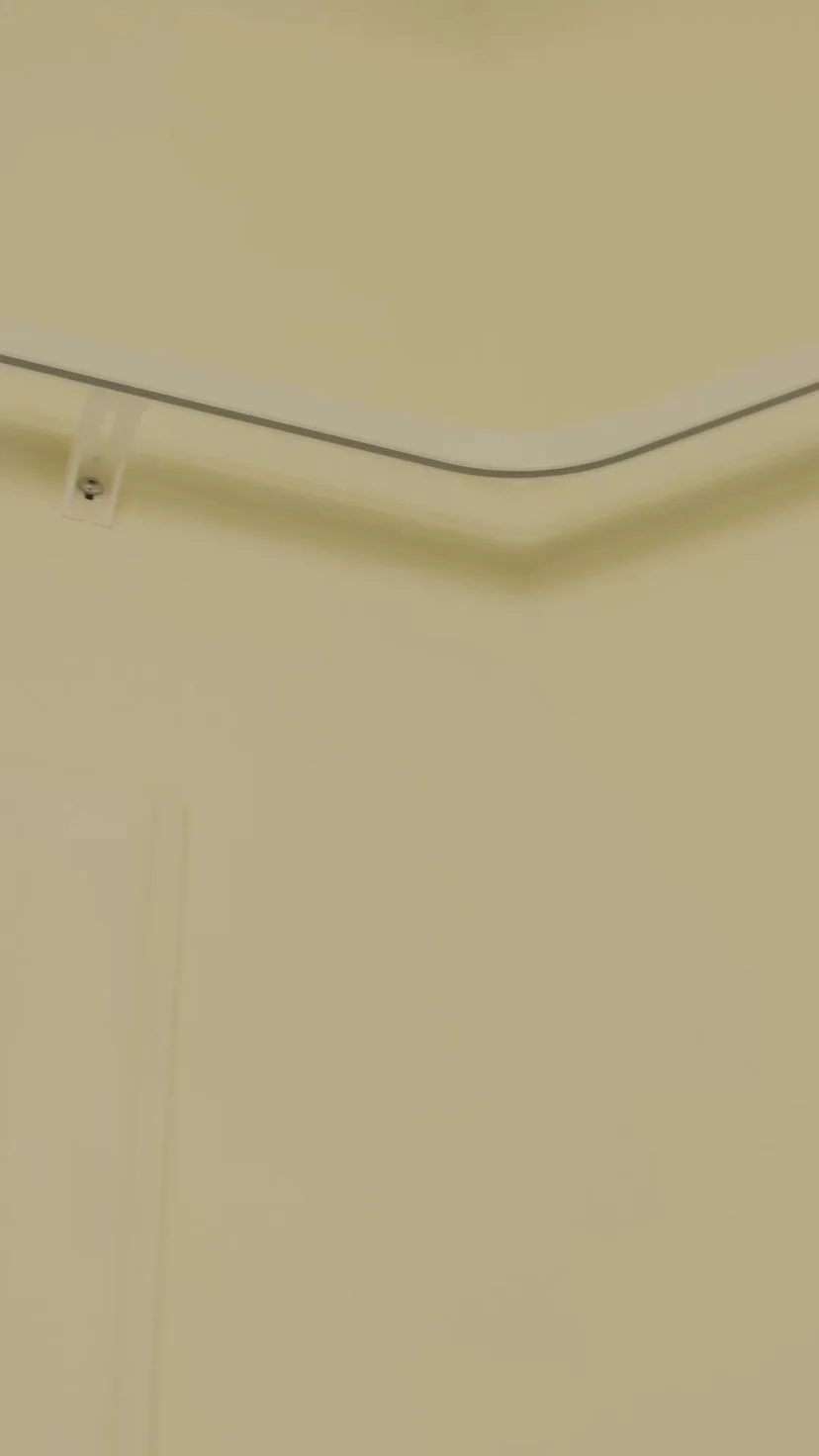
With full-length drapes, you can beautifully frame the entire bay window and allow the curtains to follow the shape of the windows. To create a curtain track that runs along the bay window, you need to measure both the lengths of the walls and the angles between them. Start by drawing a simple sketch showing all measurements and angles.
At Gotain, we offer ready-made 90° and 135° corner pieces for our curtain tracks. If your bay window has different angles or a more unusual shape, we also offer custom-made corner pieces tailored to your specific bay window.
Step 1: Measure Each Section Separately
Start by measuring each wall and window section of your bay window individually. We recommend drawing a simple sketch showing all measurements and the angles where the walls meet, usually 90° or 135°.
Not sure what angles your bay window has? Download our free printable angle guide from the product page for our custom-made corner angle to easily measure the angles at home.
Step 2: Decide Where to Install the Curtain Tracks.
Decide whether the curtain tracks should be ceiling-mounted or wall-mounted. Then plan how the tracks will meet in the corners so that the curtains can move smoothly along the entire bay window.
Step 3: Calculate the Curtain Track Lengths
Use the measurements of each wall and window section to calculate the curtain track lengths. All our corner pieces extend 7.9 in (20 cm) in each direction, so this length needs to be subtracted from the straight track sections.
How to Calculate the Track Lengths:
Side tracks: Add together all measurements for the side section, including wall areas, window trim and window recesses. Then subtract 7.9 in (20 cm) to allow for the corner piece.
Centre track: Start with the total width of the centre section and subtract 7.9 in (20 cm) for each corner piece, meaning a total reduction of 40 cm.
Step 4: Plan the drapery Width and Placement
How you position your drapes depends on both the layout of your bay window and the function you want the drapes to serve.
For Blackout Curtains:
Plan the width and placement of your drapes so that they can cover all the windows when closed. You can also use our drapery width guide to calculate the correct amount of fabric.
For a More Decorative Look:
Let the shape of the bay window and the layout of the room guide your drape placement. If there is wall space between the windows, you can hang drapess there too, creating a soft and cohesive look. If the windows meet directly in the corners, you can instead frame the bay window with full-length drapes along the outer edges.
We're happy to help you find the perfect curtain solution for your bay window. Book a free online curtain consultation for personalized advice on measurements, placement and curtain widths.